In Plain Sight report released
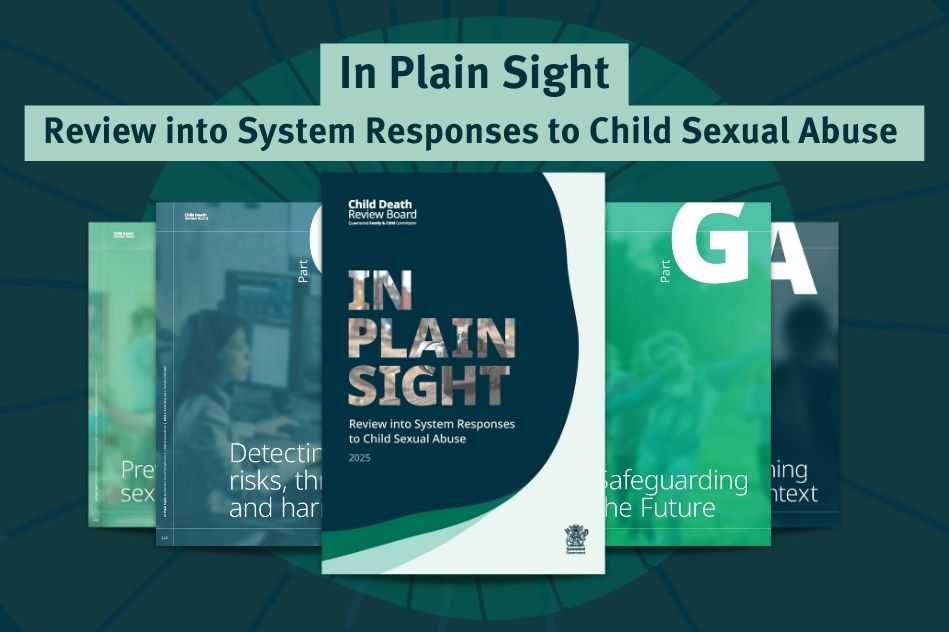
8 December 2025The Child Death Review Board (the Board) has completed its review into system responses to child sexual abuse in Queensland.
In Plain Sight is the product of a 12-month review completed by the Board. The review examined system responses to child sexual abuse, with a focus on the early childhood education and care sector, police services, and the blue card system, using the matter of Ashley Paul Griffith as a case study.
It was the broadest review of Australia’s response to child sexual exploitation since the Royal Commission into Institutional Responses to Child Sexual Abuse, and it was the first of its type in Queensland.
The report is titled In Plain Sight because those who seek to harm children are too often operating openly in our community, visible to systems, neighbours and institutions, yet unseen for who they truly are and for the risk they pose to children.
The review was built on extensive research; sector engagement; national legislative mapping; and advice from experts including Bob Atkinson AO APM, Hetty Johnston AM, Jon Rouse APM, Conrad Townson, Alison Geale, the Daniel Morcombe Foundation, victim-survivors, and national and international child safeguarding bodies.
The review team gathered extensive evidence and information throughout the review period.
Key findings
- The offending could and should have been detected and disrupted earlier.
Across organisations and agencies, sufficient concerns were recorded to have enabled earlier intervention had they been consolidated and treated as part of a broader safeguarding picture. Instead, information remained siloed, and the warning signs were never fully connected. - Parents, children and staff repeatedly raised legitimate concerns, but no obvious resolution followed.
The offender was apprehended only after uploading digital images, not because of any effective response to the concerns that adults and children legitimately expressed. - Our prioritisation of criminal justice responses means we are focused on detecting crimes rather than detecting safety threats to our children.
Consequently, opportunities to intervene are lost. Victim-survivors and their families were left with no pathway to resolve their concerns once police determined there was insufficient evidence to proceed. - Police thresholds for action, combined with resourcing limitations, further inhibited earlier detection and contributed to missed opportunities.
This left children unprotected and families unsupported, effectively closing the door on concerns despite the potential for ongoing risks. - The blue card system functioned as intended yet offered no meaningful protection to children.
At all times of his offending, the offender was entitled to, and eligible for, a blue card. The gap between the legal operation of the blue card system and community expectations of its protective factors means that trust is mislaid. - At the organisational level, actions were taken in isolation often resulting in the offender being ‘moved on’ rather than the risks he posed being systematically addressed, recorded and communicated.
Such responses delivered no strategic or holistic benefit to the community and, critically, did not safeguard children. - The legislative and policy framework is itself fragmented.
There is no clear single owner of child safeguarding in Australia or Queensland, and the response remains overly dependent on the criminal justice system and child welfare system, with a significant gap between the two. - Public submissions underscored the absence of a clear pathway to raise concerns and receive services for suspected child sexual abuse.
This evidence made it clear that there is a clear gap when neither police nor the Department of Child Safety are involved. This vacuum leaves families and organisations without a protective mechanism and children at continued risk.
Recommendations
The Board makes 28 recommendations to strengthen child safeguarding in Queensland (p.482–491).
The recommendations focus on improving leadership, institutional and organisational practice, responses to victim-survivors; strengthening intelligence gathering and actioning; building community awareness around child sexual abuse; and reforming the criminal justice system.
The complete set of recommendations are detailed from page 482 in the report.
- Empowering better collation of integrated intelligence below the criminal justice threshold in a way that enables and authorises civil law to develop and deliver threat assessments
- Transformational Recommendation 3: Create Child Safeguarding Intelligence Hub
- Provide a central point of accountability for proactively seeking intelligence, developing the integrity of the integrated intelligence hub, and pushing information to the police, regulators and organisations that are required to act
- Transformational Recommendation 9: Establish a safeguarding entity
- Lifting the safety of children as a primary issue within the mechanics of government
- Transformational Recommendation 8: Establish robust and centralised national and state governance for child safeguarding
- Strengthening the obligations on organisations to detect, prevent and respond to threats of child sexual abuse before they occur
- Transformational Recommendation 2: Preventing threats to children from entering the workforce
- Transformational Recommendation 5: Strengthen child safeguarding duties and introduce corporate and personal accountability and liability for the safety of children
- Improving the response to children who have been offended against, and their families
- Transformational Recommendation 6: Improved interviewing and responses when victim-survivors present
- Transformational Recommendation 7: Increasing the rights of child sexual abuse victim‑survivors in cases of child exploitation material
- Improve worker and community awareness of child sexual abuse, grooming and the likelihood of threats
- Transformational Recommendation 1: Create a national child safeguarding training program
- Operational Recommendation 2: Invest more in workforce capability for child safeguarding
- Operational Recommendation 3: Sustained investment in capacity building and community awareness
- Operational Recommendation 14: Empowering parents through resources, awareness and education
Media Brief
Quotes attributed to Child Death Review Board Chair Luke Twyford
“This review has been one of the most profound responsibilities I have ever carried.
“On behalf of the Board, I am privileged to present a report that confronts the uncomfortable reality of the prevalence of child sexual abuse in Queensland and proposes transformational reforms to better protect our children from harm.
“I sincerely acknowledge the courage of every victim-survivor and their families who shared their experience in this review. I recognise their hurt, suffering and betrayal, and I hope this report helps in their journey towards healing, while driving change that can benefit many others.
“What we discovered through this review was sobering—our current systems did not just fail our children; they were completely inadequate.
“Ultimately, the offending could and should have been detected and disrupted earlier.
“Risks were visible but unseen, processes existed but were too weak to protect, concerns were raised but too often dismissed, and children who disclosed harm were not always heard.
“Our review highlights how perpetrators strategically, deceptively and calculatingly exploit system gaps to groom and manipulate parents, carers, co-workers, and their employers in their pursuit to harm children.
“We found that while these perpetrators are ultimately responsible for the abuse of children, our disconnected systems are ill-equipped to appropriately prevent, detect and respond to harm.
“A system that responds only after harm occurs is not one that protects children, which is why our recommendations call for transformational reforms that delivers a child safeguarding approach in Queensland that connects systems, shares intelligence, builds community confidence to detect abuse, responds appropriately to risks, and better supports healing for those who have experienced harm.”
ENDS
For media information contact:
Vanessa Kendall | Child Death Review Board | Queensland Family and Child Commission
Phone: 0423 565 108
Email: media@qfcc.qld.gov.au
1800RESPECT (24 hours): 1800 737 732
Sexual Assault Helpline: 1800 010 120
Lifeline (24 hours): 13 11 14
13YARN Aboriginal and Torres Strait Islander Crisis Support (24 hours): 13 92 76
Beyond Blue: 1300 22 4636
Bravehearts: 1800 272 831
Victims Assist Queensland: 1300 546 587
Reporting allegations or suspicions of child sexual abuse
Every Queenslander has a responsibility to report child sexual abuse.
If you believe a child is in immediate danger or a life-threatening situation, call Triple Zero (000).
You can report child sexual abuse to PoliceLink (24 Hours) on 131 444 and the Department of Child Safety.